Sisters, question for you: what's the difference between awd and 4wd when you are shopping for an SUV, crossover, or pickup? The short answer is that both systems can send power to all four wheels, but they are designed for different kinds of driving. AWD usually works automatically on changing pavement, while 4WD is generally built for tougher terrain, deep snow, mud, and controlled off-road use. That distinction matters when you are comparing a Subaru Forester, Toyota RAV4, Jeep Wrangler, or Ford Bronco.
The naming can feel needlessly complicated, especially when every dealership sign seems to promise confidence in bad weather. Let us make it practical: which system helps on a wet commute, which one is better for a snowy mountain road, and what are you actually paying for?
AWD explained without the showroom speech
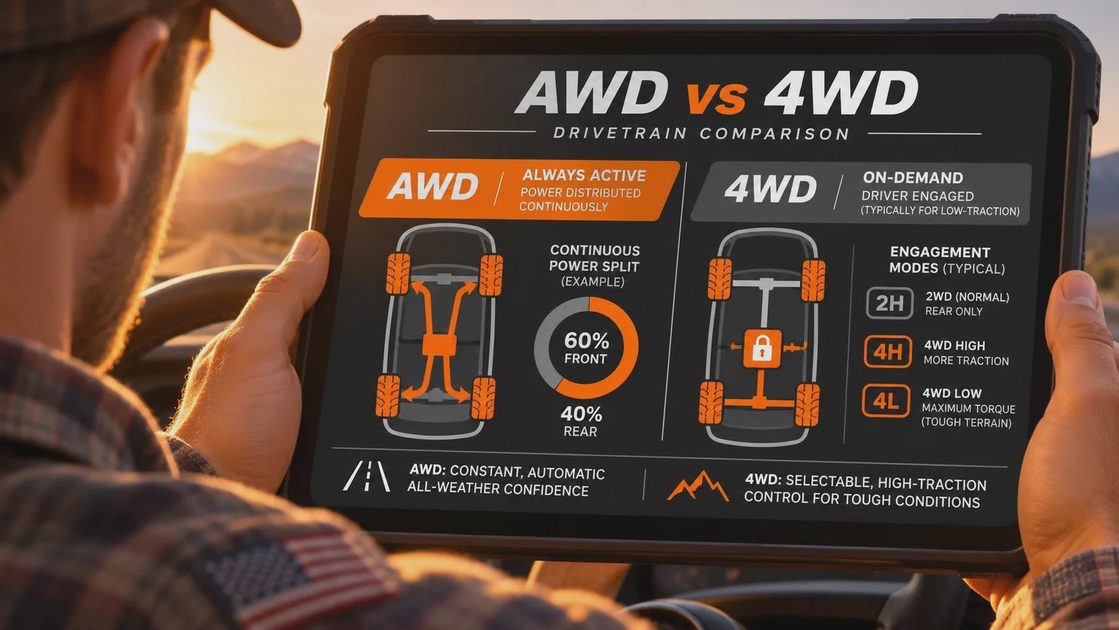
All-wheel drive, or AWD, uses sensors and computer controls to decide when the front and rear wheels need extra power. In many vehicles, the system sends power mostly to two wheels during normal driving, then shifts some power when it detects wheel slip or conditions that could cause it. Some performance-oriented AWD systems also distribute power proactively to improve handling in corners.
That makes AWD especially convenient for daily life. You do not usually need to stop and select a mode before a storm. A crossover such as the Honda CR-V, Mazda CX-50, Toyota Highlander, or Subaru Outback can adjust while you drive through rain, slush, or a lightly snow-covered street. AWD can also help a vehicle feel more planted when pulling away from a slippery intersection.
Still, AWD is not magic. It cannot create traction where the tires have none, and it does not automatically shorten stopping distance. Good all-season tires, winter tires where appropriate, reasonable speed, and smooth steering are still the foundation of a safe drive. If the vehicle has worn tires, no drivetrain can rescue the situation.
4WD has a different job
Four-wheel drive, often called 4WD or 4x4, typically uses a transfer case to connect the front and rear axles more directly. Many systems let the driver choose between settings such as 2H for ordinary pavement, 4H for loose or slippery surfaces, and 4L for slow, demanding terrain. Low range uses gearing that provides extra torque and control when climbing, crawling, or pulling through difficult ground.
This is where what's the difference between awd and 4wd becomes more than a vocabulary question. Traditional 4WD is often the better fit for someone who regularly drives unplowed roads, sandy trails, rocky paths, or steep access roads. A Jeep Wrangler, Toyota 4Runner, Chevrolet Tahoe, or Ford F-150 with a suitable 4WD system can be equipped for work and recreation that would be hard on a typical crossover.
The tradeoff is attention and hardware. Some 4WD vehicles require you to select a mode, and certain systems should not be used in 4H or 4L on dry pavement because drivetrain binding can occur. Your owner’s manual is the final word. A 4WD SUV can also weigh more, ride more firmly, and use more fuel than a similar two-wheel-drive model.
what's the difference between awd and 4wd in snow?
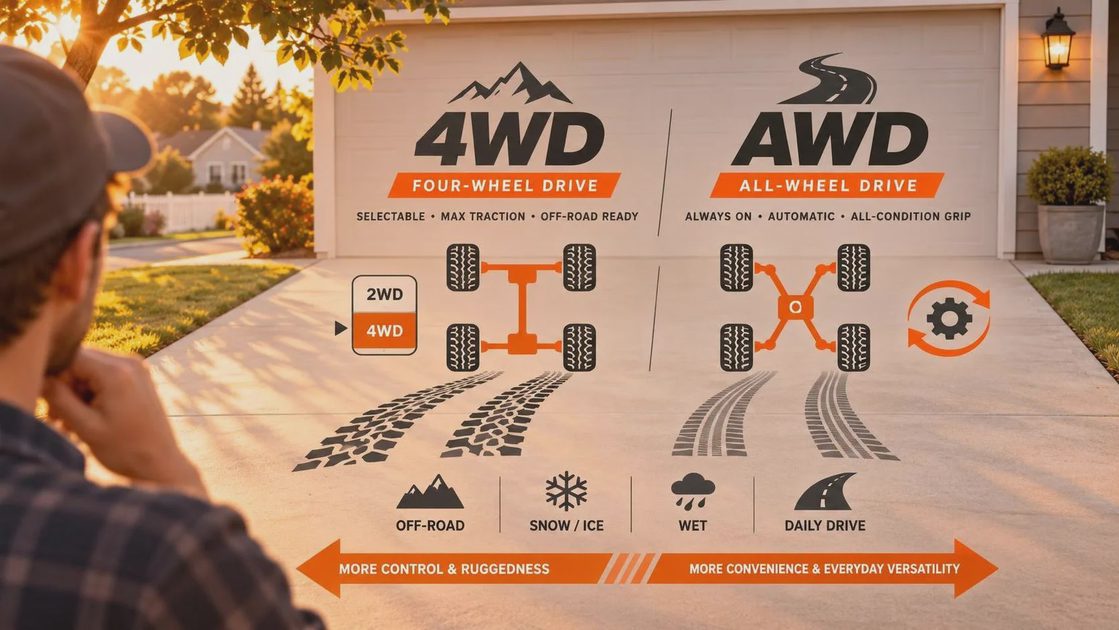
For most city and suburban drivers, AWD is the simpler snow solution. It can help you get moving when one axle encounters a slick patch, and its automatic operation is reassuring during a changing forecast. If your winter routine means clearing the driveway, driving to work, and handling a few inches of snow, an AWD crossover with quality tires may be all you need.
4WD becomes more compelling when snow is deep, roads are rarely plowed, or you live where steep grades and ice are part of ordinary travel. The ability to select 4H can help maintain forward motion on loose snow, while 4L is useful for slow control in very difficult conditions. Neither system replaces cautious driving. Braking, turning, and stopping still depend heavily on tire grip and road conditions.
Think about your actual calendar rather than the most dramatic weather video you have seen. If you face six messy commutes each winter but spend the rest of the year on clean pavement, automatic AWD may be more comfortable and convenient. If you reach a remote cabin every weekend, 4WD deserves a closer look.
What's the difference between awd and 4wd for towing and trails?
AWD can be perfectly useful for light towing, boat ramps, gravel roads, and maintained trails. A midsize crossover may offer a comfortable cabin, easier parking, and enough towing capacity for a small utility trailer or personal watercraft. Always compare the vehicle’s stated tow rating with the trailer’s loaded weight, and remember that tongue weight, passengers, cargo, and hitch equipment count too.
For serious trail driving, 4WD usually offers more control. Low range can let you move slowly without forcing the engine and brakes to do all the work. Ground clearance, approach angle, suspension protection, recovery points, and tire sidewalls matter just as much as the drivetrain. A shiny 4WD badge does not turn a street-focused SUV into a rock crawler.
The same principle applies to towing. A properly equipped 4WD truck may provide useful traction on a muddy launch ramp or construction site, but its towing confidence still depends on the engine, transmission, cooling system, brakes, wheelbase, and trailer setup. Shop the complete configuration, not just the badge on the tailgate.
Cost, comfort, and insurance considerations
AWD often adds roughly $1,000 to $3,000 to a new vehicle’s purchase price, although the difference varies by model and trim. Four-wheel drive can add a similar amount or more, particularly when bundled with off-road hardware, larger tires, skid plates, and upgraded suspension. Used pricing depends on mileage, condition, demand, and how desirable the model is in your region.
Fuel economy can differ because extra driveline components add weight and mechanical resistance. Tire replacement can also become more expensive if the vehicle requires matching tire circumference across all four corners. Some AWD vehicles need four tires replaced together to protect the system, even when only one tire is badly damaged.
Auto insurance pricing is not determined by AWD or 4WD alone. Insurers consider the vehicle’s repair cost, safety equipment, theft patterns, driver history, location, coverage limits, and deductible. Comprehensive coverage helps with non-crash losses such as theft, hail, or falling objects, while collision coverage applies to damage from a crash. Get quotes for the exact year, trim, and VIN before assuming the more rugged vehicle will cost less to insure.
How to choose the right system for your life
When asking what's the difference between awd and 4wd, start with these practical questions:
- How often do you drive on unplowed roads, deep snow, sand, mud, or rocks?
- Do you want a system that operates automatically, or are you comfortable selecting drive modes?
- Will you tow, carry heavy gear, or use a trailer on slippery ramps?
- Are fuel economy, quiet highway manners, and easy parking higher priorities than trail capability?
- Can you budget for the purchase price, tires, maintenance, and insurance of the vehicle you want?
For everyday rain, occasional snow, and a busy schedule, AWD is usually the relaxed choice. For repeated off-road travel, deep unplowed snow, demanding work sites, or serious towing, 4WD may be worth the added weight and cost. The best answer is not the toughest badge; it is the system that matches your real routes.
Before signing, test-drive the exact model, inspect the tires, ask how its modes work, and compare insurance quotes. Once you understand what's the difference between awd and 4wd, the decision becomes much less intimidating—and much more personal. What roads, weather, and weekend plans should your next vehicle handle?
No comments yet.